

- Posted by digital assignment
- Categories Dissertation, Research
- Date 15/09/2025
- Comments 0 comment
Writing dissertations, case studies, and research papers is an important part of academic life in educational institutions. An important part of these papers is citing the sources that students referred to when they were writing the papers.
Now, there are two main types of sources used, depending on the type of academic writing you’re following. These are, namely, reference lists and bibliography. But not many students know the difference between the two.
If you’re one of them, then worry not, we’ll talk about how they differ from each other. Continue reading to learn what a bibliography and a reference are below. Since these are both types of academic referencing, let’s get an idea of that first.
What Is Academic Referencing?
Academic referencing stands for crediting the sources from which you’ve drawn information for your work. You can do this by either providing some details about the source or by directly quoting their work.
For example, say you’re writing a detailed assignment on early invasive breast cancer. You could have a section as seen below.
Women who are treated early for invasive breast cancer are marginally more likely to be diagnosed with a second primary cancer, with contralateral breast cancers forming around 60% of the overall increase in England.
The fact mentioned and hyperlinked in quotes in the section is the reference from which we’ve taken our information.
These sources help demonstrate the originality of these assignments. Apart from that, sources help establish credibility. Sources also help strengthen and support the various arguments made in the article.
Another role played by sources is that they help you avoid plagiarism accusations. When you lift a quote from a source and credit it, you are making it clear that it is, in fact, a quotation and not a copied piece of information.
Some of the common citation styles include APA, MLA, Chicago, and Harvard. These styles have their own format, which helps distinguish them. Depending on which style you’re following, you can only use a reference list or a bibliography
Let’s explore more about them below.
What Is a Reference List?
A reference list refers to a series of all the sources of information that you’ve used to write the article. For example, say you’ve written about global warming and its impact on polar bears.
Within the article, you’ve mentioned information about the dwindling number of polar bears and the rate of glacial ice melting. At the end of the article, you should only mention the sources you’ve used to mention those facts.
You should not include sources for information not present within the article, or your own statements.
The basic purpose of a reference list is essentially to guide readers to the exact sources of information used. You should always place the sources at the end of the article or document
The format of a reference list depends on the style used, namely APA and Harvard.
APA Style of Academic Referencing
APA stands for the American Psychological Association. This reference style can be recognized by the author or date method of citation. You will see the surname of the author mentioned along with the year of publication in the article itself.
For example, the UK breast cancer fact will be cited in the following manner as per APA:
BMJ (Dodwell, July 2025)
This style was created in 1929. It helps you focus on the subject matter. The APA style of referencing also allows people to read through your article easily for any major points or information.
The ease of searching for information allows people to cross-check your study and arrive at the same conclusion.
Harvard Style of Academic Referencing
The Harvard Style includes in-text citations and full references. Full references stand for the alphabetical order in which the entire information of the sources is presented.
For example, consider the following reference list:
‘A, Mueller, G. Cooper and H. Goreng and (2024), Workhouse Conditions in the early 18th Century, Journal on British History, 405, article number 3045678’
‘C. Kirk, E. Schulman and G.Daxley (2022), Winter in the Irish North, Journal on Living as an Irishman, 4504, article number 8765403’*
*Note: The above references are purely hypothetical. Any resemblance to real sources is coincidental and unintentional.*
In-text citations refer to the references mentioned within the text body of your work. These citations are considered to be part of the word count. This style mentions the author’s name and the year of publication, followed by the page or paragraph number.
For example, “Xenobiology has become quite a promising research field. (A. Dent, 2025)*”.
*Note: The above references are purely hypothetical. Any resemblance to real sources is coincidental and unintentional.*
What Is a Bibliography?
A bibliography refers to a list of all the sources of information you used to write the article or dissertation. It does not matter where you’ve cited them in your text or not.
The main purpose of a bibliography is to prove to your professors that you’ve put in the work for the assignment. As mentioned in the previous sections, a lack of a bibliography can signal plagiarism or other unethical practices.
It is mentioned at the end of the research paper or article you’re writing. It is generally presented in the MLA or Chicago style of referencing.
MLA Style of Academic Referencing
The MLA style of referencing involves an in-text citation and full body referencing. The in-text citation consists of the author’s name and the page number of the journal or book they published.
For example, “The effects used in Interstellar relied on real physics (Tate, 2021).”
The full-body references refer to the complete series of links used by you for your work. Its format includes the author, title of the source, container, mentioning other contributors, version, number, publisher, publishing date, and location.
For example, This is a full-bodied reference: “Karl Tate. Science of Interstellar Infographic. Article No, 27692, Space Magazine, 2021, New York”.
Chicago Style of Academic Referencing
The Chicago Style of referencing comes in two different forms, namely, an in-text citation and notes and bibliography.
An in-text citation involves the source cited between circular brackets, followed by the author’s and year of publication. You will find the sources for these citations at the end.
This system is preferred since it directly mentions the source and the year of publication.
For example, (On The Origin of Species, Darwin, 1859) is an in-text citation.
The bibliography and notes system, the sources are cited via footnotes. The number in the end or footnotes corresponds to a superscript present within the text.
For example, “Penguins can go without food for a long time when breeding[2].”
The full note will be: [2]: “André Ancel, Michaël Beaulieu, Caroline Gilbert, Comptes Rendus Biologies, (France, Volume 336, Issue 1, January 2013, Pages 1-12).
You can also opt for a shorter note: André Ancel, Michaël Beaulieu, Caroline Gilbert, Comptes Rendus Biologies, Pages 1-12.
Our experts will help you write academic papers with accurate and properly formatted references.
Reference List and Bibliography: A Comparison
Take a look at the table below to understand the differences between a bibliography and a reference list:
| Feature | Reference List | Bibliography |
|---|---|---|
| Definition | A list of only the sources that were directly cited in the text. | A list of all sources consulted, whether cited in the text or not. |
| Purpose | To give credit to authors whose work you directly referenced. | To show the wider scope of reading and research on the topic. |
| Content | Includes only in-text citations (direct quotes, paraphrases, or data used). | Includes cited sources and additional background readings or sources not directly quoted. |
| Academic Use | Common in APA, Harvard, and some other citation styles. | Often used in Chicago, Turabian, or humanities-based styles. |
| Length | Usually shorter and more concise. | Usually longer, as it covers all sources consulted. |
| Placement | Appears at the end of an academic paper, before appendices (if any). | Also appears at the end of the paper, sometimes in addition to a reference list. |
| Reader Benefit | Allows readers to find the exact sources used in the paper. | Helps readers explore further readings related to the topic. |
Table 1: Bibliography vs Reference Lists Quick Comparison
When Should You Use A Reference and Bibliography?
You should consult with your professor or publisher as to the type of reference style they need. This will tell whether you need to use a reference or bibliography. The type of assignments where they are used is mentioned below.
| Situation | Use a Reference List | Use a Bibliography |
|---|---|---|
| You directly cite, quote, or paraphrase a source in your paper | Yes | Not required (unless style guide asks for both) |
| You only consulted a source for background reading, but didn’t cite it | No | Yes |
| Assignment guidelines specify APA or Harvard style | Yes | Not usually |
| Assignment guidelines specify Chicago/Turabian (humanities) | No | Yes |
| You want to show only the sources tied to your arguments | Yes | No |
| You want to demonstrate the full extent of your research (even uncited works) | No | Yes |
| Required by university or journal submission rules | If asked | If asked |
Table 2: Reference Lists vs Bibliography Use Cases
Wrapping Up
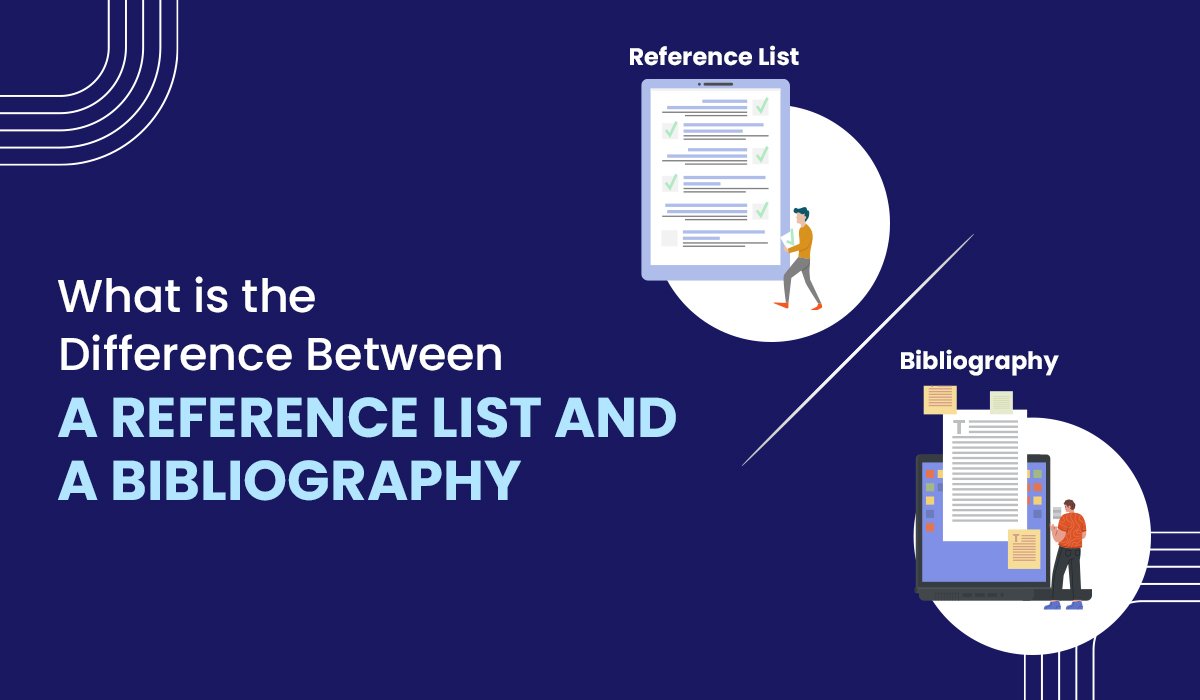
A reference list stands for a list of the sources from which you referred to information for your blog. On the other hand, a bibliography lists all the sources of information, whether or not you cited them in your article.
The right style of referencing will depend on the style guide and academic requirements of your assignment.
Confused About Which Academic Referencing to Use?
Use a reliable citation manager or consult your institution’s writing guide to avoid costly mistakes. But if you need professional assistance with your work, don’t hesitate to get in touch with us today!
Our experts will help you craft your bibliographies or reference lists and ensure that they get approved instantly.
Frequently Asked Questions
If you have a bibliography, you might not require references. However, you should consult your teacher or research sponsor. They will provide you with the correct answer.
Generally, bibliographies are used to denote sources for information that you referred to when writing something. References are used when you use the information from the sources in your article as is.
et al refers to “and others” in references. It is used when there are multiple authors for a particular study or research paper. This abbreviation ensures ease of understanding.
It depends on how you present the footnotes. In other words, if you mention the complete bibliographic information in your footnotes, you will probably not require a separate bibliography.
You should use the APA and Harvard style for reference lists, and the MLA and Chicago style for bibliographies.