

- Posted by digital assignment
- Categories Assignment
- Date 09/10/2025
- Comments 0 comment
Referencing is a widely recognised and well-established system that helps offer credit to the authors whose ideas and words are used. It lets students, authors, and researchers acknowledge the contribution of others in their work. Endnote and footnote referencing offer the choice between clutter-free and immediate contexts.
Not citing the sources and listing the references in an appropriate style can result in plagiarism. It is often considered a case of academic misconduct. But referencing styles can be confusing for students. Hence, this article aims to help students understand the differences between footnotes and endnotes.
What Is A Footnote?
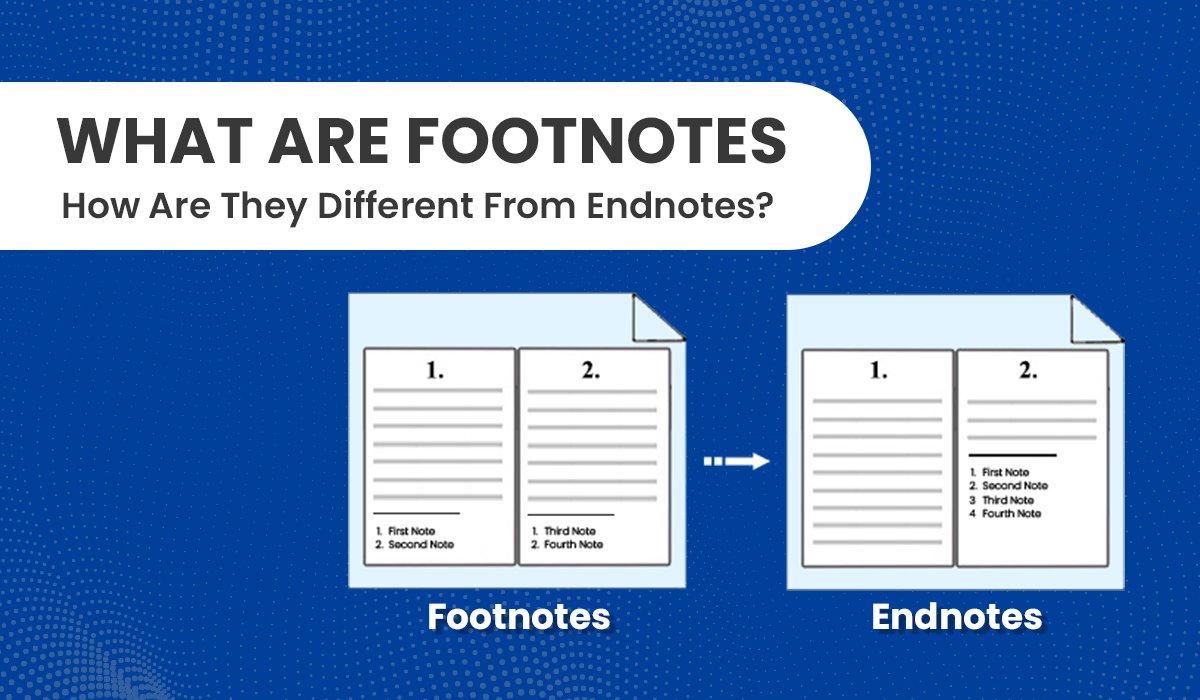
Footnotes are supplementary texts that you can find at the bottom of a page. Footnotes are marked by superscript numbers. These numbers serve as the citations for the sources they correspond to in the reference list in footnote text. Footnotes can also be used for providing additional explanations or contexts. Footnotes are great for conveying information clearly without disrupting the flow of the main text.
You can think of a footnote as a piece of text that is placed at the bottom of the page for citing sources or providing additional context for the main text. If you are wondering how to use footnotes, here is the basic formatting.
- Superscript Numbers: Superscript numbers are just small-font numbers that appear above the baseline of regular text. A superscript number appears with every source of information listed in the footnote text.
- Sequential Numbering: The superscript numbers are sequentially assigned to the list of sources in the footnote text. They are assigned in the order of citations followed in the main text.
- Placement: A superscript number is placed at the end of relevant sentences in the main text. The actual footnote text containing a numbered list of sources can be found at the bottom of a page.
- Style Guides: The exact format for footnotes is typically dependent on the specific reference style used, such as the Chicago referencing system. Here is an example of citing using footnotes in the Chicago style.
| Main Text: | Sufficient sleep can improve concentration levels by helping consolidate new information and form new memory pathways in the brain.1 |
| Footnote Text (Bottom of the main text page): | 1. Novianti, Sri Wulandari, Meli Andriyani, and Dwi Hastuti. “The Relationship between The Quality of Sleep and Learning Concentration among School-Age Children.” Journal of Nursing Care 5, no. 3 (2022). |
Table 1: Example of Footnote
Pro Tip: How to insert footnote in word? Move your cursor to the point in the text where you want to place the citation or reference mark. Next, go to the “References” tab and click on “Insert Footnote.” Then, you must enter your notes or reference lists at the bottom of the same page. Microsoft Word is capable of automatically linking reference numbers with corresponding footnotes.
What Are Endnotes?
Endnotes are also numbered supplementary pieces of information. They are citations that are placed at the end of a chapter or an entire article. Compared to footnotes, endnotes help keep texts more clutter-free.
Endnote text is written on a separate page instead of at the bottom of the same page where the main text exists. So, with endnotes, you have to accommodate longer notes in the main text. Lengthy footnotes take up much of the space on a page. Here is the basic formatting of endnotes.
- Superscript Numbers: A superscript number is placed in the main text at the end of a relevant sentence.
- Number Placement: The superscripted number that you will use to cite a source should appear at the end of punctuation marks.
- Dedicated Notes Section: The reference list corresponding to the superscript number citations must appear at the end of a chapter or document on a separate page titled “Notes.”
- Numbering: Endnotes are consecutively numbered from start to finish, with main text citations and endnote entries following the same order. Here is an example of citing using endnotes in the Chicago style.
| Main Text: | Sufficient sleep can improve concentration levels by helping consolidate new information and form new memory pathways in the brain.1 |
| Footnote Text (Bottom of the main text page): | 1. Novianti, Sri Wulandari, Meli Andriyani, and Dwi Hastuti. “The Relationship between The Quality of Sleep and Learning Concentration among School-Age Children.” |
Table 2: Example of Endnote
Find professional assistance to boost your academic credibility with flawless footnotes.
Key Differences Between Footnotes and Endnotes
Footnote vs. Endnote is a topic that creates confusion for many. Students often mix them up because of how closely the two are related. Both involve the use of superscript numbers to denote citations within the main text. The two also cover the same subject, such as commentaries and source citations.
The main difference between footnotes and endnotes is related to the placement of the supplementary notes. Here is a quick recap on footnotes vs. endnotes.
You have to place endnotes in a separate page or section after the main text pages. This typically includes the end of a chapter, an entire article, an academic paper, or a book.
You have to place footnotes at the bottom of the page containing the main text. If you cite a source in the main text, the footnote entry should be placed at the bottom of the same page.
Here is an overview of footnotes vs. endnotes.
| Feature | Footnotes | Endnotes |
|---|---|---|
| Placement | Bottom of the page. | End of chapter, section, or document. |
| Readability | It may clutter the main page and interrupt the flow of reading. | Keep the main text clutter-free and maintain the flow of reading. |
| Purpose | Short and on-page explanations and citations. | Longer explanations and comprehensive references. |
| Use Case | Provide quick clarification or context to specific phrases, words, or information | Detailed argument or full source citations for supporting points. |
| Format | Must appear on each page involving a citation. | Must only appear at the end of a document, chapter, or section. |
Table 3: Footnotes vs. Endnotes
When Should You Use Footnotes?
Footnotes are great for use in short documents. Readers can check the footnotes for immediate reference or context. So, footnotes are particularly useful for providing a quick view of supplementary information like copyright permission or clarifications.
Footnotes will add transparency to your work without requiring the readers to flip pages to check sources and contexts of information. If you are writing a detailed analysis or articles on law and historical events, then footnotes will be helpful.
When Should You Use Endnotes?
Endnotes are useful when you want to write longer academic works like dissertations, theses, or books. It is particularly suitable for documents that require extensive referencing. So, for preventing visual clutter and maintaining a clean layout of the main text, all the reference lists and notes are consolidated and placed in a separate page after a section or the entire write-up ends.
Endnotes are suitable for providing tangential or secondary information, as readers don’t immediately seek the source or context. It is less distracting and ensures that the reading experience for the main text remains cohesive.
Need Assistance With Endnotes and Footnotes?
Footnotes and endnotes are often used interchangeably. The two are more similar than they are different. This is why clearly understanding the placement of notes is important. It is the placement of the notes that gives distinct purpose to footnotes and endnotes.
Remember that footnotes go at the bottom of the page, while endnotes are consolidated on a separate page. So, footnotes are great for providing quick reference, while endnotes still allow supplementary information but in a less cluttered layout.
If you are still not confident about the use of the two, you can always seek assistance from an online assignment help service. So, reach out to one today!
Frequently Asked Questions
Standard formats like Harvard and APA are based on in-text citations. The names of authors and the publishing year of the source are displayed in the main text, while a list of full references goes at the end of the article. While in-text citations are useful, they can also be disruptive to the flow of text. But with endnotes, you can keep the main text clutter-free and leave it to the readers whether they want to learn about the information source.
No, superscripting the number is fundamental. It is almost a universally accepted style or format for endnotes and footnotes. You may find some citations using other formats of numbering, like Roman numerals. But superscripting the number is the standard practice.
Not using a consistent format for the numbering system is a common mistake made by students when using endnotes and footnotes. Mixing the two styles in the same document is another major mistake.
No, there is no universal rule about the density of footnotes on a page. However, it is important that you don’t use excessive footnotes. Otherwise, your page may look cluttered and overcrowded with references and citations. Use endnotes if you need to include too many references or contextual information.

You may also like